Make room
for better work.

I’m Mark. I help brands, retailers, and creative teams organize product information, manage content, and improve the tools and processes behind the work. Most of the teams I work with have more products, channels, and content than their setup was built for.

How I see it

The problem usually starts upstream.

Most of what I get asked about starts in the same place. A launch slips because product details are missing. A page sits in review because the copy and the images live in two different systems. Underneath both is the same problem. The team wants better pages, better search, and more personal experiences, and the product information can’t support that yet. Anything you’d want AI to help draft or tag runs into the same limit, since it can only work from what’s already there.

I think the useful work is finding the part of the foundation that’s holding your team back, fixing that part, and letting the results decide what comes next. Sometimes that does mean a new tool. A lot of the time the fix is in the data model, the rules, and the handoffs around the ones you already have.

Four places the work gets stuck.

The catalog, the content, the platforms they live in, and the handoffs between people. Most delays trace back to one of these four, and the starting point is whichever one your team keeps running into.

I trace those delays back to their source with the people doing the work, then help change the information, tools, or handoffs causing them.

Catalog

Product details shouldn’t hold up a launch.

I review a sample of your catalog for missing attributes, inconsistent descriptions, and confusing variants. I check it against channel requirements and the details customers need to compare products.

Then I help define what’s required, where it comes from, and who maintains it. I test the rules on real products before applying them across the catalog. Where it helps, I set up AI-assisted enrichment for the descriptive fields, with checks so that facts like dimensions and materials only ever come from a source you trust.

What I can put in place

Product data models, channel requirements, validation rules, enrichment guardrails, and launch checks.
Content

Finding the right asset shouldn’t mean starting over.

I follow how copy and imagery are created, stored, approved, and reused. With your team, I identify duplicate versions, gaps in page structure, and updates that take too much effort.

I help organize the library and define reusable content types, and where the volume calls for it I add AI-assisted tagging and first drafts inside the approval steps your team already uses. I also review navigation, page hierarchy, and accessibility so customers can find and understand the content.

What I can put in place

Content templates, asset metadata, naming rules, and a plan for reuse and revision.

Platforms

The tools should support the way people work.

I walk through common tasks with your team and map how information moves between platforms. That exposes manual copying, awkward configuration, and missing connections.

I help configure platforms, define integrations, and automate repeatable steps, including automated checks that compare live pages against your content and component standards. For design systems, I work through components, content rules, keyboard behavior, and accessibility with the people building and maintaining them. The system behind this site is documented the same way, and the working example below runs on a platform I set up from scratch.

What I can put in place

Platform configuration, integration requirements, workflow automation, automated page checks, and documented components.

Workflows

Work gets stuck between people, too.

I trace a recent request from brief to publication. I look at where it waited, why it came back for revisions, and which decisions depended on one person.

With your team, I simplify approvals, assign ownership, and define what each handoff needs. I trial the process on actual work and adjust it before documenting it for the next person.

What I can put in place

Clearer briefs, approval responsibilities, quality checks, and workflows the team can follow.

A working example

See it working before we talk.

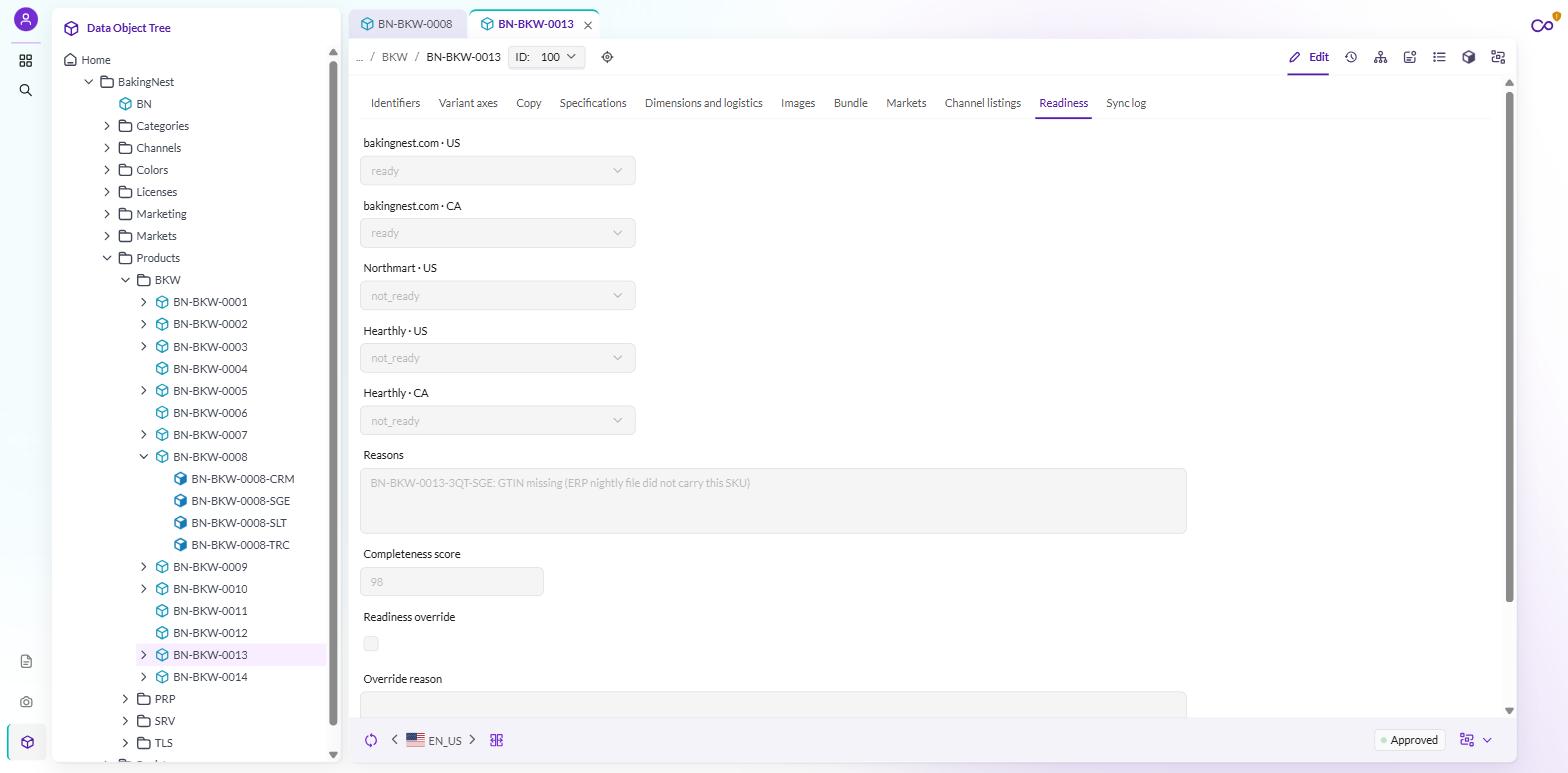
Most of what I describe on this page is hard to picture from a paragraph, so I built it. BakingNest is a housewares brand I made up: fifty products, three sales channels, two countries, three languages, and the rules that decide whether a product is allowed to go out. It runs on Pimcore, an open-source product information system, with a storefront on top and a guide that walks you through it stop by stop.

You can open a product that a retailer would have pulled and read the reason on the record, see the retailer’s requirements written down as data, find out who owns each field, and look at the files that go out to each channel. Twenty minutes for the whole tour; the short version is three stops. Leave an email on the landing page and the login arrives with the guide.

The editing screen inside the demo, showing a product record
Inside the demo.

About the practice

What N4mation Digital does.

N4mation Digital works with your team on the product information, content, and tools behind your channels, and stays on for the part where the changes have to be put into use. I lead the work myself, so the person who heard the first call is the person doing the configuration and writing the documentation. When a project needs more hands than mine, I work with your team to scope the roles, find the people, and write the proposal that gets it approved, which I’ve done many times from the other side of the table.

The practice comes out of fifteen years spent on this problem from three seats. For the first stretch I ran the teams that prepared catalog and content for launch, so I know where that work stalls in practice. Later I owned the platforms those teams used, and selected, configured, and rolled them out across brands with different needs. I also spent a couple of years on the vendor side, which is a useful way to learn what an implementation looks like when it goes well and what it looks like when it doesn’t. I tend to fix things in the order those years taught me, which is usually the data model and the handoffs before the tools.

Quality and readiness
Products that are complete, correct, and approved for every channel before the launch date, and a report that says which ones aren’t and why.
Brands across verticals
Apparel, consumer products, and furniture, from single-brand sites to a PIM shared by more than twenty brands.
Fewer steps, fewer hands
Content pipelines rationalized so a product is entered once and reused everywhere, which has removed thousands of hours of manual merchandising work a year.

Working together

Start with
a call.

Bring a current project or a recurring problem. The first step is a call, with no fee, where we walk through how the work happens today and where it keeps getting stuck. Most of the time that’s enough for me to say what needs attention first and what can wait.

If it makes sense to go further, I’ll propose a defined project for your approval: what I’ll change, what I’ll need from your team, and how I’ll assess the result. I can also provide ongoing support after that.

Get in touch

What are you
working on?

Tell me about your team, what you’re trying to change, and where you need help. If you’d rather look first, the demo is open.

contact@n4mation.digital